

Digital Citizenship Starts Earlier Than We Think
Digital citizenship is often treated as a topic for teenagers. We usually connect it with social media, online identity, misinformation, cyberbullying, privacy settings and digital footprints. However, children begin developing digital habits much earlier than adolescence. Long before they create their first social media account, they are already watching videos, playing online games, using tablets, clicking on content, sharing devices with siblings or friends, and forming ideas about what is acceptable, safe or “normal” online.
This is why digital citizenship starts earlier than we think.
For children aged 8–13, the digital world is not something separate from everyday life. It is part of how they play, communicate, learn, imagine, and relate to others. Online games, video platforms, and digital communities shape their understanding of friendship, fairness, privacy, trust, risk, and self-expression. A child who plays an online game is not only learning how to win or complete a level; they may also be learning how to communicate with others, how to react to mean comments, how to manage frustration, how to recognise suspicious behaviour, and how to ask for help when something feels wrong.
If education systems wait until adolescence to introduce digital citizenship, they arrive too late. By that point, many behaviours have already become habits. Children may already have learned to ignore uncomfortable situations, accept online aggression as normal, share information without thinking, or believe everything they see online. Early education does not mean exposing children to adult digital concerns too soon. It means giving them age-appropriate language, tools and confidence to understand the spaces they already use.
Effective digital citizenship education should not be based on fear. Children do not only need warnings about danger. Children benefit from
A strong approach also recognises children as active participants, not passive recipients of protection. When children are invited to design games, discuss online risks, create safety messages or reflect on digital dilemmas, they do more than memorise rules. They develop judgement. They learn to connect digital safety with empathy, creativity, problem-solving and responsibility. This is particularly important because children’s online experiences are not the same for everyone. Gender, age, confidence, family rules, access to technology and social context can all influence how children experience digital environments.
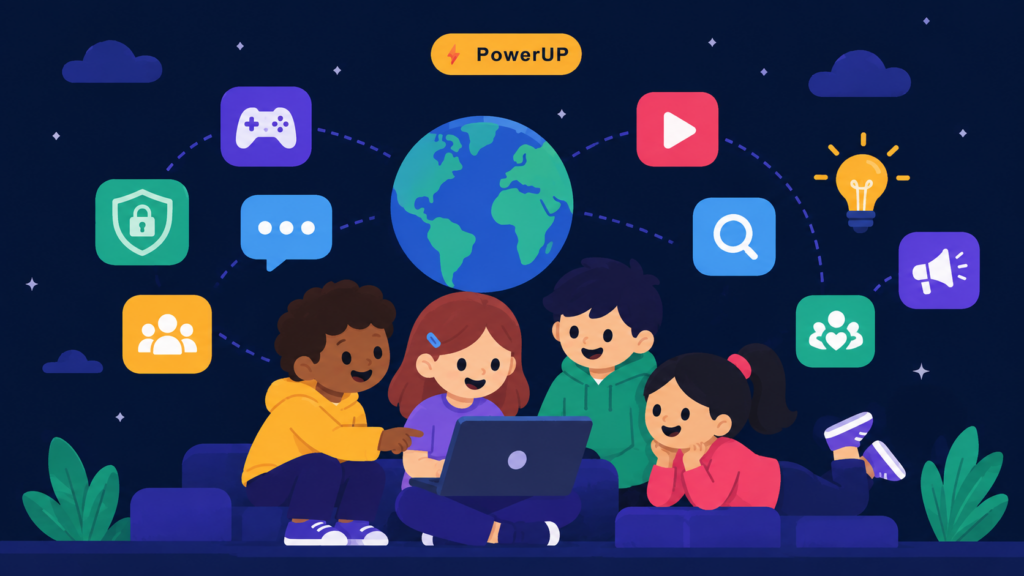
Projects such as PowerUP are valuable because they place children at the centre of digital safety education. Instead of speaking about children only as vulnerable users, PowerUP treats them as young citizens who can think critically, create solutions and contribute to safer digital spaces. Through game-based learning and co-creation, children can explore complex issues such as cyberbullying, privacy, fake news, hate speech and online strangers in ways that are meaningful, participatory and appropriate for their age.
Digital citizenship is not only a technical skill. It is a social, ethical and democratic competence. It is about how we behave when we are online, how we protect ourselves and others, how we evaluate information, and how we use technology to participate in the world around us. It begins with small everyday choices: what we share, how we speak, who we trust, when we ask for help, and how we treat others behind a screen.
If we want children to become safe, critical, kind and confident digital citizens, we must begin early. Not by frightening them, and not by removing them from the digital world, but by helping them navigate it with care, awareness and voice.
References
Council of Europe. (2019). Digital Citizenship Education Handbook. Council of Europe Publishing.
OECD. (2019). Educating 21st Century Children: Emotional Well-being in the Digital Age. OECD Publishing.
UNESCO. (2023). Global Education Monitoring Report 2023: Technology in education – A tool on whose terms?
UNICEF. (2017). The State of the World’s Children 2017: Children in a Digital World.