

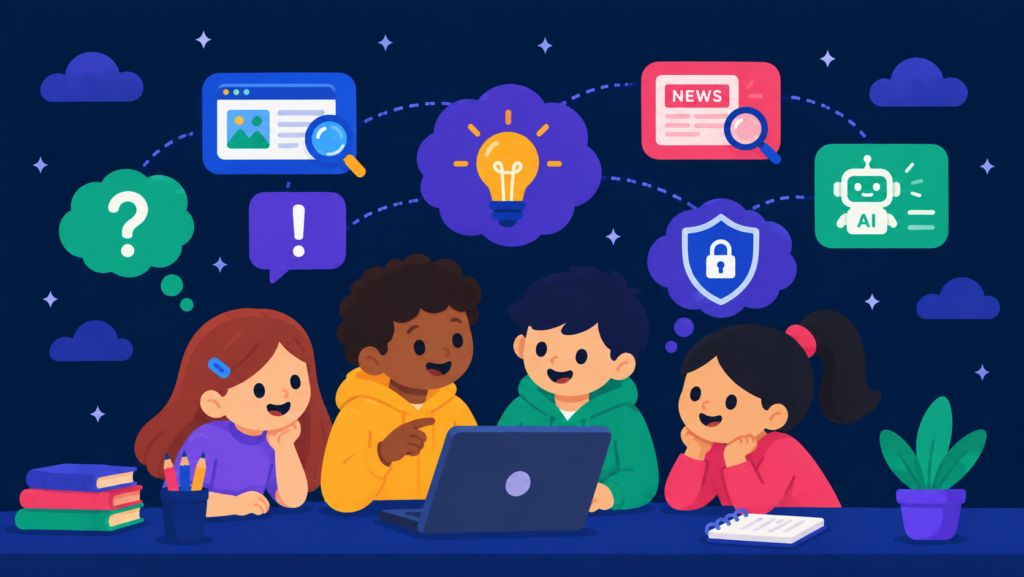
Beyond Clicking: Teaching Children to Think Before They Trust Online
The most important digital skill children can develop is not learning how to click, it is learning how to think before they click.
Today’s children are growing up in a world where information is limitless, artificial intelligence is becoming part of everyday life, and digital platforms increasingly shape the way they learn, communicate and make decisions. For children aged 8 to 13, the question is no longer whether they will use technology, but whether they will develop the skills needed to question it, understand it and use it responsibly.
This is where critical thinking becomes essential.
Critical thinking is much more than identifying fake news. It is the ability to ask questions, evaluate information, recognise manipulation, consider different perspectives and make informed decisions. Research consistently shows that these skills can and should be developed from an early age, helping children become more confident learners, better problem solvers and more responsible digital citizens (Facione, 1990; Vincent-Lancrin et al., 2023).
However, critical thinking does not develop simply by telling children what is right or wrong online. It grows through experience. Children learn best when they explore, experiment, make decisions, solve problems and reflect on the consequences of their choices.
This educational philosophy lies at the heart of the PowerUP project. Rather than teaching online safety through traditional lessons, the project empowers children to design their own educational video games about online challenges. By becoming creators instead of passive users of technology, children learn to analyse problems, think creatively, collaborate with others and transform ideas into meaningful digital experiences.
Designing a game is far more than a technical exercise. It requires imagination, logical reasoning, empathy and decision-making. Children must ask themselves: What problem am I trying to solve? How will players react? What message do I want them to remember? Every decision strengthens not only digital skills but also creativity, resilience and problem-solving abilities.
These are exactly the competences that young people will need in a future shaped by artificial intelligence and rapidly evolving digital technologies. As information becomes easier to generate, the ability to evaluate it becomes even more valuable. In an age where anyone can create convincing images, videos or text using AI, teaching children how to think is becoming more important than teaching them what to think.
The PowerUP project also reflects the European Union’s vision for education. The Digital Education Action Plan 2021–2027 highlights critical thinking, digital literacy and responsible technology use as key competences for the future. Likewise, Erasmus+ promotes creativity, innovation, active participation and digital transformation, while the CERV Programme supports children’s rights, democratic participation and resilience against online risks.
By combining game design, creativity and digital citizenship, PowerUP transforms online safety education into an engaging learning experience that encourages curiosity rather than fear. Instead of simply warning children about the dangers of the internet, it gives them the confidence to question, create and participate responsibly.
Because the goal is not simply to raise children who know how to navigate technology.
It is to raise a generation that knows when to question, how to solve problems and why thinking critically will always be their greatest digital superpower.
References
European Commission. (2021). Digital Education Action Plan 2021–2027.
European Commission. (2021). Erasmus+ Programme Guide 2021–2027.
Facione, P. A. (1990). Critical Thinking: A Statement of Expert Consensus for Purposes of Educational Assessment and Instruction.
Livingstone, S., & Stoilova, M. (2021). The 4Cs: Classifying Online Risk to Children.
Vincent-Lancrin, S., Urgel, J., Kar, S., & Jacotin, G. (2023). Fostering and Assessing Students’ Creative and Critical Thinking Skills. OECD.